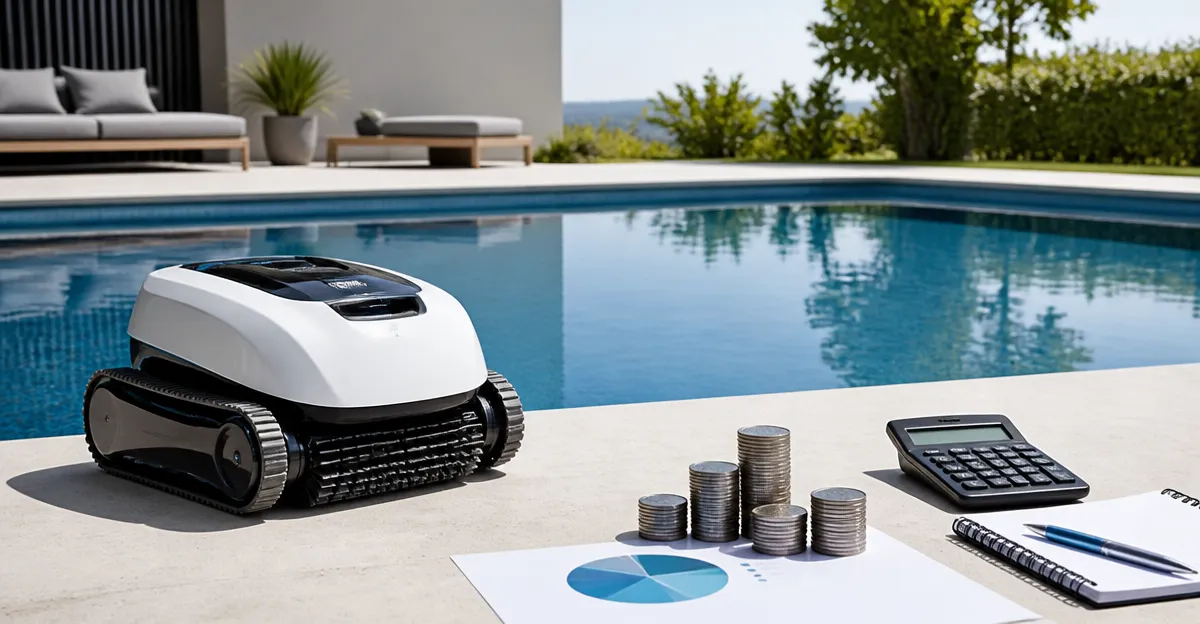
Cordless Robotic Pool Cleaner Annual Operating Cost: The Ultimate Guide to Yearly Energy, Maintenance & Savings
Introduction
Homeowners with private pools increasingly rely on cordless robotic cleaners to keep water crystal clear while reducing manual labor. This guide explains how to calculate the yearly operating cost of these devices, covering electricity consumption, filter replacement, battery wear, and routine upkeep. Readers will learn how to compare models, identify hidden expenses, and adopt best‑practice maintenance strategies that extend service life and maximize savings.
Background and Context
Traditional pool vacuums are tethered to a power outlet, which limits mobility and creates safety concerns. Cordless robots integrate high‑capacity lithium batteries, intelligent navigation, and multi‑stage filtration, allowing them to clean floors, walls, waterlines, and shallow areas without a cord. The shift to cordless technology introduces new cost factors: battery charging cycles, firmware updates, and occasional filter upgrades. Understanding these variables is essential before selecting a system that fits both the pool’s size and the owner’s budget.
Key Concepts for Calculating Annual Costs
Three primary categories determine the total cost of ownership:
- Energy Consumption: Measured in kilowatt‑hours (kWh) per cleaning cycle, multiplied by local electricity rates.
- Maintenance Supplies: Replacement filters, brushes, and occasional seal or gasket parts.
- Battery Degradation: Expected number of charge cycles before capacity drops, influencing replacement frequency.
Each category can be quantified using data supplied by manufacturers and typical usage patterns. The following sections illustrate the calculation method and recommend products that excel in each area.
Energy Consumption Estimates
Most cordless robots operate between 40 and 80 watts while cleaning. To estimate annual electricity cost, use the formula:
Annual kWh = (Power (W) ÷ 1,000) × Runtime per Cycle (hrs) × Cycles per Week × 52
Assume a moderate pool owner runs the robot three times per week, each cycle lasting 2.5 hours. For a 60‑W unit, the calculation yields:
(60 ÷ 1,000) × 2.5 × 3 × 52 = 23.4 kWh per year
At a national average electricity price of $0.13 per kWh, the annual energy cost is roughly $3.00. While this figure appears negligible, it becomes significant when multiple units or higher‑power models are used.
Maintenance Supplies and Replacement Parts
All featured robots employ dual‑stage filtration: a coarse 180‑micron mesh and an ultra‑fine 3‑micron insert. The coarse filter typically lasts six months in a residential setting, whereas the ultra‑fine insert may require replacement annually if the pool experiences heavy dust or sand.
Typical replacement costs (based on market averages) are:
- 180‑micron mesh: $12–$18 per set
- 3‑micron ultra‑fine insert: $20–$30 per set
Adding a small reserve for occasional brush wear ($10‑$15 per year) yields an estimated $45‑$65 annual maintenance budget.
Battery Life and Replacement
Lithium‑ion batteries in modern pool robots are rated for 300‑500 full charge cycles before capacity falls below 80 % of the original rating. Assuming a user cleans three times per week, the robot will complete roughly 156 cycles per year. At 400‑cycle endurance, the battery should remain functional for 2.5 years, suggesting a replacement cost every 2–3 years. For budgeting purposes, amortize the battery price over its lifespan.
Example battery costs:
- Aiper Scuba S3 – Included, estimated $120 replacement after 3 years.
- Aiper Scuba V3 – Included, estimated $150 replacement after 3 years.
- Beatbot Sora 10 – Included, estimated $100 replacement after 2 years.
Amortized annual battery cost therefore ranges from $40 to $60, depending on the model.
Product Recommendations Integrated with Cost Analysis
The following robots illustrate how different specifications impact the total cost of ownership. Each product is linked at its first mention, and key data points are highlighted.
1. Aiper Scuba S3
The Scuba S3 offers a lightweight 18‑lb frame, 240‑minute ECO runtime, and a waterline scrub that reaches two inches above the surface. Its dual‑stage filtration (180 µm + 3 µm) ensures clear water after each cycle. With a 4.8‑star rating from 114 reviews, users praise its ease of use and reliable customer service. Energy consumption is modest (≈55 W), resulting in an annual electricity cost of about $3.50. Maintenance costs align with the average $55 figure, and the battery amortization adds roughly $40 per year, yielding an estimated total of $98 per year.
2. Aiper Scuba V3
The V3 introduces AI‑enhanced debris detection, enabling ten‑times faster cleaning. It provides up to 240 minutes in ECO mode and 180 minutes in intensive modes. Weighing 8.2 kg (≈18 lb), it remains portable while delivering powerful suction. The wireless charging dock eliminates corded charging hassles. At a price of $949.99 and a 4.8‑star rating from 57 reviews, it is positioned as a mid‑range premium model. Its higher power draw (≈70 W) raises the annual electricity cost to $5.00, but the time saved may justify the expense. Annual maintenance remains $55, and battery amortization is $45, for a total of approximately $115 per year.
3. Beatbot Sora 10
The Sora 10 delivers 6,800 GPH suction, a 300‑minute runtime, and a 5‑liter debris basket. It supports both Wi‑Fi and Bluetooth control, and it is fully salt‑water safe. With a 4.6‑star rating from 96 reviews, owners appreciate its value‑for‑price proposition. Energy usage is around 65 W, translating to $4.30 per year. Maintenance costs are slightly higher due to the larger basket (estimated $65 annually). Battery replacement is expected every two years, resulting in a $50 annual amortization. The projected yearly cost is about $119.
4. Aiper Scuba S1
The S1 balances runtime (up to 270 minutes in ECO) with intelligent navigation using 11 high‑precision sensors. Its dual‑filtration system and 2‑year warranty make it a reliable choice for larger pools. At $539.99 and a 4.3‑star rating from 875 reviews, it sits between the S3 and V3 in price. Power consumption is roughly 60 W, yielding an electricity cost of $4.00 per year. Maintenance and battery amortization follow the same pattern as the S3, resulting in an estimated $100 annual cost.
5. WYBOT C1
The C1 provides 160 minutes of runtime on a high‑capacity lithium battery and uses a gyroscope‑based navigation system. It is priced at $399.99 with a 4.1‑star rating from 1,042 reviews. Energy draw is about 50 W, giving an electricity cost of $3.25 per year. However, user feedback indicates battery longevity concerns, potentially increasing replacement frequency to every 1.5 years. Amortized battery cost therefore rises to $70 annually, and maintenance remains $55, for a total of roughly $128 per year.
Comparison and Selection Guide
| Model | Price (USD) | Runtime (Eco) | Power (W) | Annual Energy Cost | Annual Maintenance | Battery Amortization | Total Estimated Yearly Cost |
|---|---|---|---|---|---|---|---|
| Aiper Scuba S3 | 699.99 | 240 min | ≈55 | $3.50 | $55 | $40 | $98.50 |
| Aiper Scuba V3 | 949.99 | 240 min | ≈70 | $5.00 | $55 | $45 | $115.00 |
| Beatbot Sora 10 | 469.00 | 300 min | ≈65 | $4.30 | $65 | $50 | $119.30 |
| Aiper Scuba S1 | 539.99 | 270 min | ≈60 | $4.00 | $55 | $40 | $103.00 |
| WYBOT C1 | 399.99 | 160 min | ≈50 | $3.25 | $55 | $70 | $128.25 |
When selecting a robot, consider pool size, desired cleaning frequency, and tolerance for battery replacement intervals. For owners of medium‑sized pools (≈15,000 L) who value fast cleaning and AI‑driven efficiency, the Aiper Scuba V3 offers the best balance of speed and long‑run time, albeit at a higher upfront cost. Budget‑conscious buyers seeking reliable performance may favor the Beatbot Sora 10, which provides a generous runtime and strong suction for a modest price.
Best Practices & Tips for Minimizing Operating Costs
- Schedule Regular Cleaning Cycles: Running the robot three times per week prevents heavy debris buildup, reducing strain on filters and batteries.
- Maintain Filter Hygiene: Rinse the 180‑micron mesh after each cycle and replace the 3‑micron ultra‑fine insert annually to avoid reduced suction and excess energy draw.
- Optimize Battery Health: Store the robot in a cool, dry environment when not in use. Avoid deep discharge by charging after each cleaning session if possible.
- Leverage Smart App Features: Use scheduling, diagnostic alerts, and OTA firmware updates to keep the robot operating at peak efficiency.
- Inspect Seals and Gaskets Annually: Replace worn O‑rings before they cause water leakage, which can lead to motor overload and higher electricity consumption.
Frequently Asked Questions
- How much electricity does a cordless pool robot actually use? Most models draw between 40 W and 80 W. At typical residential rates, annual energy costs range from $3 to $6.
- Do I need to replace the battery every year? No. Batteries are rated for 300‑500 full cycles. With three cleanings per week, replacement is usually required every 2‑3 years.
- Can I use the robot in a salt‑water pool? Yes. The Beatbot Sora 10 is explicitly salt‑water safe, and the Aiper models are built with corrosion‑resistant materials suitable for low‑salinity environments.
- What is the typical lifespan of the filtration cartridges? The coarse 180‑micron mesh lasts about six months in average conditions, while the 3‑micron ultra‑fine insert should be replaced annually for optimal water clarity.
- Is wireless charging worth the extra cost? Wireless docks, such as the one bundled with the Aiper Scuba V3, eliminate exposed connectors and reduce maintenance time, making them valuable for users who prioritize convenience.
- How do I know when the robot needs service? Most robots send real‑time alerts via their companion apps when battery levels are low, filters are clogged, or diagnostic checks detect a fault.
- Can I run the robot continuously? Continuous operation is limited by battery capacity. For most models, a single charge provides 2‑5 hours of cleaning, after which the robot must recharge.
Conclusion
Calculating the annual operating cost of a cordless robotic pool cleaner involves more than the purchase price. Energy consumption, filter replacement, and battery depreciation together form the true cost of ownership. By understanding these elements, pool owners can select a model that aligns with their budget and performance expectations. Whether one chooses the AI‑driven Aiper Scuba V3, the value‑focused Beatbot Sora 10, or another capable robot, the guide equips readers with the data needed to make an informed, cost‑effective decision.
Products Featured in This Guide
Aiper Scuba S3
Price: $699.99 | Rating: 4.8/5 (114 reviews)
Featured for its lightweight design, 240‑minute ECO runtime, and superior waterline scrubbing that eliminates scum rings.
Aiper Scuba V3
Price: $949.99 | Rating: 4.8/5 (57 reviews)
Featured for its AI‑Patrol system that detects over 20 debris types, wireless charging dock, and fast cleaning speed.
Beatbot Sora 10
Price: $469.00 | Rating: 4.6/5 (96 reviews)
Featured for its 6,800 GPH suction, 300‑minute runtime, and salt‑water safe construction.
Aiper Scuba S1
Price: $539.99 | Rating: 4.3/5 (875 reviews)
Featured for its 270‑minute ECO runtime, 11 high‑precision sensors, and adaptive navigation that reduces missed spots.
WYBOT C1
Price: $399.99 | Rating: 4.1/5 (1,042 reviews)
Featured for its gyroscope‑based navigation, 160‑minute runtime, and affordable price point for smaller inground pools.