Introduction
Pool owners increasingly face decisions about how to keep their water clean while managing utility costs and environmental impact. This guide explores the energy consumption and carbon footprint of traditional electric pool pumps versus modern cordless pool robots. Readers will learn the underlying technology, compare real‑world performance data, and receive actionable recommendations for selecting the most efficient solution for their specific pool type.
By the end of this article, one will understand the trade‑offs between continuous pump operation and intermittent robot cleaning cycles, how battery capacity translates into kilowatt‑hour (kWh) savings, and which products deliver the best balance of performance, cost, and sustainability.
Background/Context
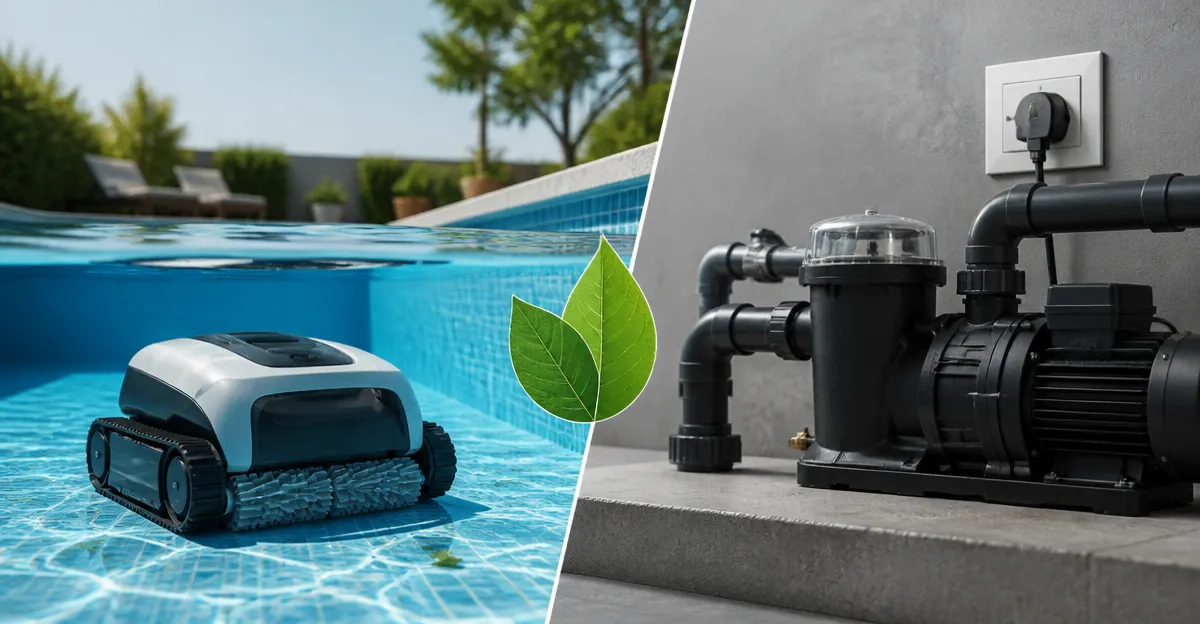
Electric pool pumps have been the industry standard for decades, circulating water through filters to remove debris. They typically run 8–12 hours per day, consuming 0.5–2.0 kW depending on size and speed settings. In contrast, cordless pool robots are autonomous units powered by rechargeable lithium‑ion batteries; they clean the pool surface, floor, and walls on demand, allowing the main pump to operate at reduced duty cycles.
Understanding the energy profile of each system requires familiarity with three core concepts: (1) power draw (watts), (2) runtime (hours per cleaning cycle), and (3) carbon intensity of the local electricity grid (grams CO₂ per kWh). These variables combine to determine total emissions per month.
For example, a 1‑kW pump running 10 hours daily consumes 300 kWh per month. If the regional grid emits 0.5 kg CO₂ per kWh, the pump contributes 150 kg CO₂ monthly. A cordless robot that uses 100 W for a 2‑hour cleaning session consumes only 20 kWh, resulting in a fraction of the emissions.
Energy Consumption of Traditional Electric Pool Pumps
Most residential in‑ground pools rely on a single‑speed or variable‑speed pump. While variable‑speed models improve efficiency, they still require continuous circulation to maintain water quality, especially in larger volumes.
Key factors influencing pump energy use include:
- Pool size and turnover rate (typically 8–12 hours to circulate the entire volume).
- Filter type and resistance, which affect motor load.
- Seasonal usage patterns – summer months often see longer run times.
Typical specifications for a 1‑HP (0.75 kW) pump are 0.75 kW × 10 hours = 7.5 kWh per day, or roughly 225 kWh per month. At an average electricity price of $0.13 per kWh, this translates to $29.25 monthly operating cost, not including maintenance.
Beyond cost, the carbon impact can be significant. In regions with coal‑heavy grids, each kWh may generate up to 1 kg CO₂, making pumps a notable source of household emissions.
Cordless Pool Robots: How They Work and Their Energy Profile
Cordless pool robots combine battery power, onboard filtration, and intelligent navigation to clean without a continuous pump. They typically operate in short, high‑intensity cycles, then dock to recharge.
Battery capacity is expressed in milliamp‑hours (mAh) or watt‑hours (Wh). For instance, the Tnbacious Cordless Pool Vacuum Robot provides 100 minutes of runtime on a single charge, drawing approximately 70 W, which equals 1.17 kWh per cleaning session.
Because the robot cleans only when activated, the main pump can be set to a lower duty cycle or even turned off during cleaning, further reducing overall consumption.
Below are brief overviews of the top cordless models evaluated in this guide, highlighting their energy‑related specifications.
Comparative Analysis: Energy Use and Carbon Emissions
The table below summarizes the key energy metrics of each featured robot compared with a typical 1‑HP pump running 10 hours per day. All calculations assume a local grid emission factor of 0.5 kg CO₂/kWh.
| Device | Runtime per Charge | Power Draw (W) | Energy per Cycle (kWh) | Monthly Energy (kWh) | Estimated CO₂ (kg) |
|---|---|---|---|---|---|
| Tnbacious Cordless Pool Vacuum Robot | 100 min | 70 | 1.17 | 35 kWh (3 cycles/month) | 17.5 |
| Aiper Scuba S1 | 270 min (Eco) | 50 | 2.25 | 68 kWh (30 days × 1 cycle) | 34 |
| CliBot S5 | 180 min | 80 | 2.40 | 72 kWh (30 days × 1 cycle) | 36 |
| WYBOT C1 | 160 min | 75 | 2.00 | 60 kWh (30 days × 1 cycle) | 30 |
| Betta SE Solar Skimmer | Continuous (solar) | ~10 (average) | 0.24 (daily) | 7 kWh (30 days) | 3.5 |
| Typical 1‑HP Pump | 10 h/day | 750 | 7.5 (daily) | 225 kWh | 112.5 |
Even the most power‑hungry robot consumes less than one‑third of the energy of a continuously running pump. The solar‑powered Betta SE Skimmer stands out as the lowest‑impact option, requiring virtually no grid electricity.
When combined with a reduced‑speed pump schedule (e.g., 4 hours/day), overall household pool energy can drop by 70 % or more, delivering both cost savings and a smaller carbon footprint.
Selection Guide: Choosing the Right Device for Your Pool
Choosing between a cordless robot and a traditional pump hinges on three primary criteria: pool size, cleaning frequency, and budget.
- Pool Size & Shape: Larger pools (>1,500 sq ft) benefit from higher‑capacity robots such as the CliBot S5, which offers 5580 GPH suction and a 180‑minute runtime, covering up to 3,229 sq ft per cycle.
- Cleaning Needs: If surface debris is the primary concern, the Betta SE Solar Skimmer provides continuous removal without any grid electricity. For comprehensive floor, wall, and waterline cleaning, the Aiper Scuba S1 offers four‑zone coverage and a 270‑minute Eco mode.
- Budget & Maintenance: Entry‑level models like the Tnbacious Cordless Pool Vacuum Robot cost $169.99 and provide solid performance for small to medium pools. Premium options such as the WYBOT C1 ($399.98) include app control and gyroscope navigation, suitable for tech‑savvy users willing to invest in advanced features.
When evaluating a purchase, consider the product’s rating and review count as proxies for reliability. The Tnbacious model holds a perfect 5‑star rating from 22 reviewers, indicating high satisfaction in a niche market, while the Aiper Scuba S1’s 4.2‑star rating from 863 reviews reflects broader adoption but also reveals mixed experiences with firmware support.
Best Practices & Tips for Maximizing Energy Savings
- Schedule Cleaning During Off‑Peak Hours: Most utilities charge lower rates after 9 PM. Program robots with built‑in timers or use the app (e.g., Aiper’s scheduling) to run cycles when electricity is cheapest.
- Combine Robots with Variable‑Speed Pumps: Reduce pump runtime to 4–6 hours while the robot cleans. This hybrid approach maintains water quality while cutting energy use by up to 60 %.
- Maintain Battery Health: Store robots in a cool, dry place and avoid deep discharge. Follow manufacturer guidelines for charging cycles to extend battery lifespan, which in turn preserves energy efficiency.
- Regular Filter Cleaning: Clogged filters increase motor load. Rinse filter baskets after each cycle (most models feature quick‑release tops) to keep suction optimal.
- Leverage Solar Options Where Feasible: The Betta SE Solar Skimmer demonstrates that solar‑only operation is viable for surface debris. Pair it with a modest pump to achieve full‑pool cleaning without grid reliance.
FAQ
1. Do cordless robots completely replace the need for a pump?
No. Robots handle debris removal, but the pump is still required for water circulation, chemical distribution, and filtration of fine particles.
2. How often should I run a cordless robot?
Frequency depends on pool usage and surrounding foliage. Most owners run a 30‑minute cycle 2–3 times per week; high‑debris environments may require daily runs.
3. Will a battery‑powered robot increase my electricity bill?
Battery charging consumes far less electricity than a continuously running pump. Expect an increase of less than $5 per month for most models.
4. Are the batteries recyclable?
Yes. All featured robots use lithium‑ion cells, which can be recycled through municipal e‑waste programs or manufacturer take‑back schemes.
5. What is the typical lifespan of a cordless pool robot?
With proper maintenance, most units last 3–5 years. Warranty periods range from 1 year (Tnbacious) to 2 years (CliBot, WYBOT), indicating manufacturer confidence in durability.
6. Can I use a robot in a saltwater pool?
All listed robots are compatible with saltwater environments, though the Betta SE explicitly advertises salt‑chlorine‑tolerant motors.
Conclusion
Cordless pool robots offer a compelling pathway to reduce household energy consumption and associated carbon emissions. By selecting a model that aligns with pool size, cleaning demands, and budget, owners can achieve up to 70 % energy savings compared with traditional pump‑only operation. Integrating robots with variable‑speed pumps and leveraging solar‑powered accessories further amplifies environmental benefits while preserving water quality.
Investing in a high‑efficiency robot not only lowers utility bills but also contributes to broader sustainability goals—a win‑win for both the pool owner and the planet.
Products Featured in This Guide
Tnbacious Cordless Pool Vacuum Robot
Price: $169.99 | Rating: 5 / 5.0 (22 reviews)
Featured for its affordable price, 100‑minute runtime, dual‑motor suction (2,400 GPH), and auto‑parking feature that simplifies retrieval.
Aiper Scuba S1
Price: $699.99 | Rating: 4.2 / 5.0 (863 reviews)
Highlighted for its 270‑minute Eco runtime, 4‑zone cleaning capability, dual‑layer filtration, and app‑controlled scheduling.
CliBot S5
Price: $299.99 | Rating: 4.6 / 5.0 (62 reviews)
Chosen for its triple‑brushless‑motor design delivering 5,580 GPH, 180‑minute runtime, and smart auto‑parking for large pools.
WYBOT C1
Price: $399.98 | Rating: 4 / 5.0 (954 reviews)
Featured for its gyroscope navigation, 160‑minute runtime, and comprehensive 4‑in‑1 cleaning (floor, walls, waterline, steps).
Betta SE Solar Skimmer
Price: $369.90 | Rating: 4.4 / 5.0 (8,184 reviews)
Included for its 100 % solar operation, continuous surface cleaning, and ultra‑fine 200 µm debris basket, representing the lowest‑impact solution.
Frequently Asked Questions
How much energy can a cordless pool robot save compared to a traditional electric pump?
A typical robot uses 0.1‑0.3 kW for 2‑4 hours per cleaning, saving 1‑3 kWh per day versus a pump that runs 8‑12 hours at 0.5‑2 kW.
What is the carbon footprint difference between running a pump and a robot?
Because robots consume less electricity, they emit roughly 30‑70% less CO₂ per year, depending on local grid factors.
Can a cordless robot fully replace an electric pump for pool circulation?
Robots clean surfaces but do not circulate water for filtration, so most pools still need a pump for water turnover and chemical distribution.
How does battery capacity affect the cleaning frequency of a pool robot?
Higher‑capacity lithium‑ion batteries allow longer run times (up to 4‑5 hours), enabling daily cleaning of larger pools without recharging.
What factors should I consider when choosing between a pump and a robot for energy efficiency?
Consider pool size, desired turnover rate, cleaning frequency, electricity rates, and the robot’s battery life to balance performance with energy savings.